
07. Nov. 2025
Nach dem antisemitischen Vorfall, bei dem ein Schweizergardist vergangene Woche zwei Mitglieder der jüdischen Delegation am Rande einer Tagung zu "Nostra aetate" verächtlich gemacht und in ihre Richtung gespuckt haben soll, hat sich nun eine der Betroffenen zu Wort gemeldet und Details zum Vorfall geschildert. Katholisch.at dokumentiert das von der Nachrichtenagentur Kathpress geführte Interview mit der israelischen Autorin Michal Govrin im Folgenden im Wortlaut (englisches Original):
Please explain in detail, how the incident took place. Who was involved? What exactly happened? And how did you and the other person react?
I came to Rome from Jerusalem for the anniversary of the declaration Nostra Aetate with high expectations. I came not only as an official delegate but as the daughter of a father who fled the pogroms in Ukraine and was one of the founders of the state of Israel, and a mother who survived the Holocaust, whose son - my half-brother – was murdered in the gas chambers of Auschwitz. And yet she never lost her faith in humanity and her hope for peace and life.
I was reassured when the Pope, Leo XIV, clearly condemned antisemitism and strongly emphasized the bond between the Catholic Church and the Jewish people. In a cosmopolitan ceremony, replete with colorful dances from different traditions and a choir of children, I was filled with hope in seeing the Church’s acceptance of all religions as man's paths to God. I was optimistic that in our world, a religious message could make a change and bring us closer to peace. This was a path sketched by Nostra Aetate and carried by its legacy, yet one that these days needs a push forward. I was rejoicing, despite some disturbing shades.
My companion turned to the guard: "You said les juifs", "No, I didn’t" lied the guard brazenly, "And now you are lying…" As an answer, the guard made an act of spitting in our direction with clear contempt.
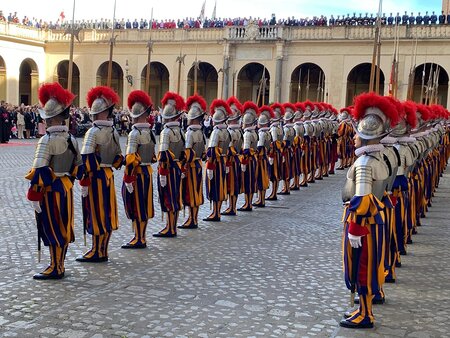
The next morning, as myself and a colleague – two women who usually are not recognizable as Jews – walked through a side entrance to St. Peter’s square as part of an international delegation of Jews, a member of the Papel Swiss Guard noticeably hissed at us with deep contempt, "les juifs" (The Jews).
Next to me was Vivian Liska, professor of German Literature, director of the Institute of Jewish Studies in Antwerp, Distinguished Visiting Professor at the Hebrew University and member of the German Academy for Language and Literature. She is also a daughter of Holocaust survivors.
We looked at each other, in complete shock. Such an incident inside the Vatican?! A blunt expression of Jew-hatred, and in such stark contrast to the Pope's declaration of last night, just prior to declaration that we had gathered to hear this morning with a huge international audience?!
My companion turned to the guard: "You said les juifs", "No, I didn’t" lied the guard brazenly, "And now you are lying…" As an answer, the guard made an act of spitting in our direction with clear contempt.
When we complained to the Vatican authorities, the supervisor apologized profusely and said that the guard would be investigated. But the incident certainly left a mark.
What kind of reaction of the Swiss Guard would you appreciate?
Of course, I would have preferred that the incident would not have happened at all! But at that moment I realized how stereotypes about Jews are so deeply rooted, so embedded in the consciousness and unconsciousness of believers, based on generations of incitement and prejudice. And they are resurging again, freely, all over the world these days. I understood that we have a long way to go in order to eradicate them, and for people to learn to relate to the Jewish people without them. Nostra Aetate was a blessed breakthrough that needs to be constantly remembered and broadened, amid a changing world.
How would you describe the atmosphere of the whole event? Did you feel welcome and understood? Or did the incident fit into an atmosphere of some kind of „oppression“?
I was happy that the declaration of Nostra Aetate from the Second Vatican Council, formulated after the Holocaust, was celebrated so clearly as relevant for our time, and that a three-day-long conference at the Gregorian University was held to do so. I was happy to see the deep change in the Catholic Church, with its openness to cultural and religious diversity and pluralism. And I was reassured by Pope Leo XIV’s and Cardinal Kurt Koch’s statements in the ceremony at the Vatican, as well as in the public address at St. Peter’s square immediately after the incident. The old attitude of the Catholic Church to the Jews was courageously changed 60 years ago. This change is a source of hope that other persistent conflicts, religious but also political, could be solved in a similar way and spirit.
Yet, there was lots of hope and courage. I felt that religion could be a tremendous and powerful factor in creating a world of peace and acceptance, as it reaches people around the world and touches the heart of humankind.
Yet the atmosphere was tense. A rabbi was cursed and spat at by a stranger in the street, and the shameful incident that we experienced overshadowed the optimism. This made it clear that the 60-year process of reconciliation initiated by the Catholic Church is not yet complete: strong and continued effort is required in today's world.
We came to the Vatican after two years of a long and complex war in Gaza and in Israel; a war which started with the horrors perpetrated by Hamas, followed by Hezbollah in Lebanon, and the Houthis in Yemen and with several direct attacks from Iran who coordinated it all; a war that caused the death and uprooting of thousands of Palestinians and Israelis and misery for the region. In his public address Pope Leo XIV made it clear that politics and conflicts should not interfere in the process of spiritual rapprochement and mutual acceptance. But it was clear that the terrible violence of the war demands a very heavy price of the inter-religious dialogue of Christians and Jews, with unprecedented attacks on Jews and Israel all over the world. I understood that we, as Jews, will be always singled out, and that this is part of our mission and destiny in the world.
Yet, there was lots of hope and courage. I felt that religion could be a tremendous and powerful factor in creating a world of peace and acceptance, as it reaches people around the world and touches the heart of humankind.
The event as a whole was dedicated to "Nostra aetate" and the theological and ecclesiastical shift in view of Judaism and the relation of christianity to judaism. Did you recognize signs of this shift in the kind of how theologians encountered you and the other members of your delegation? Which steps should be taken by the church to avoid incidents like the one that took place?
I believe the encounter in Rome was an additional positive and official step in the long path toward amending the painful relationship between the Catholic Church and the Jewish people. This is a history that touches the core of Christian identity, and is of existential dimensions for Jews, too. There is still great work to be done ahead of us – and in all forms of communication – in order to uproot the deeply-embedded prejudice against the Jews in parts of the Catholic heritage, and to relate to the Jews as equal human beings.
We live in a changing world. There are encouraging new voices emerging from the Catholic Church, and we also met some extremely committed Catholic thinkers and leaders during our visit.
We live in a changing world. There are encouraging new voices emerging from the Catholic Church, and we also met some extremely committed Catholic thinkers and leaders during our visit. “Israel” is not only an ancient religious entity but also a new national entity in the old homeland of Zion, next to the Palestinian nation. The Jews are gathered in it from all over the world looking for refuge and freedom. As a democratic state Israel has its light and dark sides which are addressed by free internal debate and struggle. The Jewish people have always contributed to the welfare of the world in a myriad of ways and continues to do so nowadays. There is an ongoing challenge to the world, currently very prominent, to accept the State of Israel as an equal member in the family of nations and enjoy its contributions.
As a resident of Jerusalem, I expressed in my writings the wish that Jerusalem, so desired by the three monotheistic religions, Judaism, Christianity and Islam, as the singled-out "Beloved", would become "The City and Mother" to all - a loving Mother who embraces her sons and daughters, and have in its bosom a peaceful place for all and everyone. And I hope that Nostra Aetate will be implemented in the spirit of peace among all nations and religions.
Interview: Dr. Henning Klingen, Kathpress
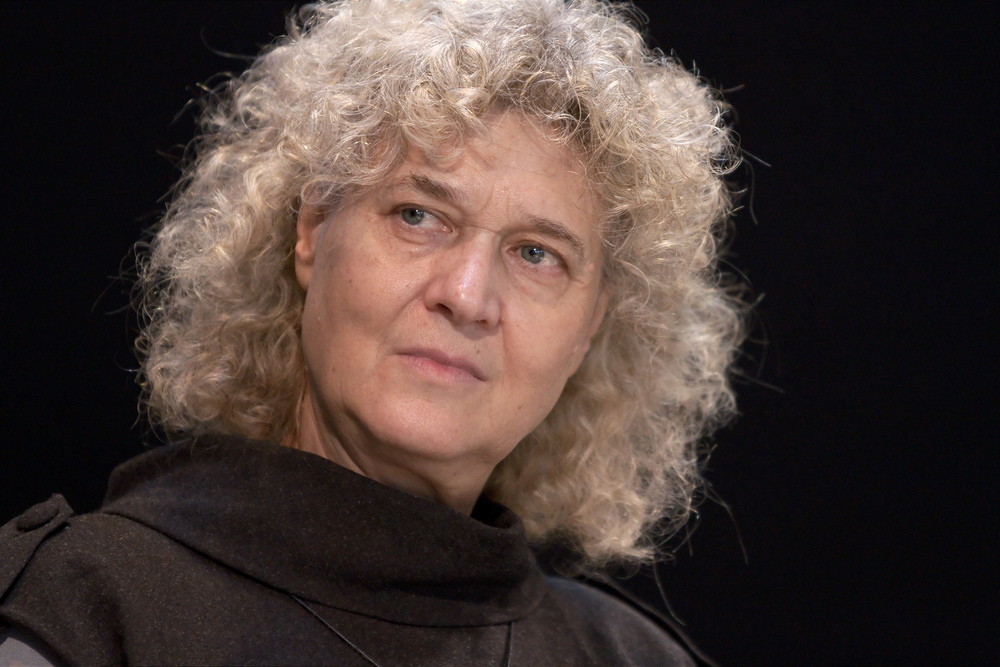
Foto: Georges Seguin (Okki), CC BY-SA 3.0, via Wikimedia Commons